1/04/2013

What is a "Nuc?"


What is a “Nuc?” 

The term “Nuc” is short for Hive Nucleus. It is bees and a queen on 5 frames used as a starter colony. The 5 deep frames contain worker bees, drawn out comb, a laying queen, eggs, larvae, and sealed and emerging brood. 

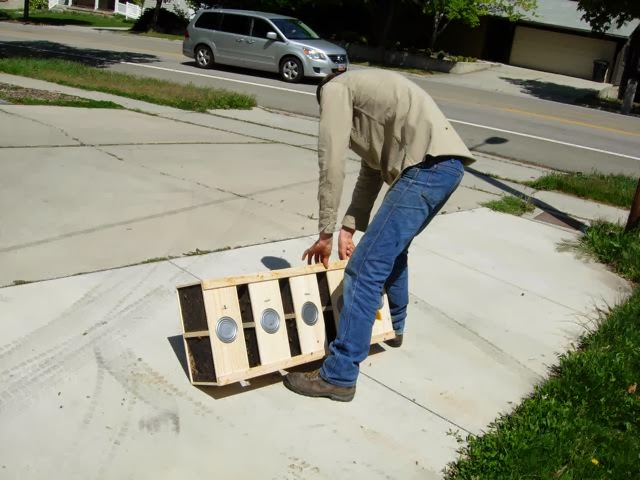
Nucs are usually kept in a half-sized deep box called a nuc box, which contains 5 frames instead of the standard 10. Below from left to right, there is one standard 10-frame box, 1 nuc box with a lid, and 1 nuc box with lid removed. 


Nucs are formed either by splitting an existing colony or by installing a package into a nuc box and nursing it along for a few months. 

Nucs do not include the box, only the frames with bees. Nucs are often transferred into a deep hive body box when they outgrow their nuc box (or at purchase). 


Below we are transferring nucs from nuc box to deep hive body box at our beekeeping class. The beekeeper carefully lifts frames from the nuc box with the hive tool. 


See lots of bees working hard on drawn comb.


Then he gently places frames from the nuc into the new deep hive body box.


The 5 frames from a nuc are placed in the center of the 10-frame hive body box, with 2-3 new frames on the outside.

Why buy nucs?
  1. The price difference between packages and nucs is only $25 when you add everything up.
  2. When packages arrive in Utah from sunny California, it often rains for a few weeks after. The lack of flight time and nectar flow causes the queen to temporarily stop laying eggs. This stunts the colony’s growth and beekeepers may need to feed the bees. 
  3. We generally sell our nucs later in the spring, after the coldest weather. We get your bees through this difficult transition and sell you a colony, which has been inspected for a good queen and brood. 
  4. We take the risk and get the bees started. You are less likely to waste money and time, and more likely to have a positive first experience. 
  5. We raise packages into nucs right here in Utah. They have a chance to become acclimatized to Utah weather patterns before you buy them. (Some of our competitors bring in CA packages. Then the weather risk is still involved.)
Sometimes nucs get a bad reputation for being a means of transferring disease. This can be the case when starting bees on old frames with old foundation. The wax cells can be storage places for disease. However, we start all of our bees on new frames and new foundation to eliminate this concern. 

What is a package, exactly?

Packages, nucs, hives, boxes. . . We throw beekeeping terms around a lot and I thought it would be good to define a few of them, starting with “packages.” 

A package is basically a wooden cage full of bees used as a starter colony. 


The one above has 3 pounds of worker bees (yes, they measure them by the pound at the bee breeder), a metal can full of sugar syrup, and a separate cage with the queen inside. 


There is enough sugar syrup in the can to feed the bees for just under a week.


The queen comes in her own little cage like these two here. One of these smaller cages is clipped to the inside of the package. The outside of the queen cage is almost always covered with her attendant bees.


At the bee breeder, they shake bees from a donor colony into individual cages. At Koehnens, they line up  donor colonies for shaking. (This photo is actually their queen rearing operation, but shows hives all lined up as an example.)


Once package cages are full, and nailed together in rows, they are placed on a truck and driven from California back to Utah. Shipping bees is an art in itself. 


Then packages are unloaded and ready to sell locally.


Here we are getting ready to shake one of these packages into a hive body box.  


Click here for a video demonstration on how to install packages by the shaking method.

11/24/2012

Rogue Comb-Building


One of the disadvantages that beginning beekeepers have is that they are starting with entirely new frames with new foundation rather than drawn comb. Frames without drawn comb next to each other have excess space and frequently the bees will draw out comb off the foundation. 


Notice how the bees built hexagon cells sideways, with the long ends parallel with the foundation rather than perpendicular

Below is an example of comb drawn out normally, filled with honey, and then capped over with wax. (We added the butterfly, see “Bee Art” for more info.)


Bees will fill in spaces with comb until there is a 3/8-inch space between. This is called the “Bee Space.” The bee space is just the right amount of room for bees to move around in the hive. In Langstroth hives, the frames have been engineered so this space is created between frames after the bees draw out comb. 

In the sideways example, notice how bees created bee space between rows of sideways comb.


Honeybee Pests: Mice


Here is an example of mice getting into beekeeping equipment. They build a nest in this one. Mice are really only a problem if there are no bees in the box. This can happen if a colony dies in the winter, if mice can get to stored boxes, or if the wintering hive is clustering in the box above, and bees are unaware of the mice below.

To avoid this, store equipment in a pest free place, especially if the hive has died in the winter. Also, if the fall cluster is not big enough to fill two boxes, consider wintering in one box. This will keep out the mice and give bees less space to heat.

If this does happen in your equipment, it needs to be carefully cleaned as mice can spread disease to humans.

Honeybee Pests: Target Practice


This hive was damaged by bullets in a remote location. It seems that shooters were using this hive as target practice. No substantial harm can come to the bees unless a bullet hits the queen, which is unlikely. But damage to the woodenware can be significant and no one wants lead in their honey.  


To avoid this kind of damage, it is best to place hives where people can’t see them.


Honeybee Pests: Livestock


This bee box was in the same pasture as a horse. The horse kicked it and several others, damaging the equipment. Two of the three kicked colonies survived, including this one. 

Livestock will occasionally cause damage to beehives. Livestock are more likely to harm the colony in winter than in other seasons, because of chill. Horses can kick the boxes and break them, especially if the've just been stung. Cattle sometimes rub on boxes and flip the lids off, or knock over a box. Goats like to jump on top of boxes. 


If a beekeeper was trying to decide whether or not to use a location based on shared use with livestock, it usually doesn’t present a problem, but it depends on the animals’ temperament. Some beekeepers fence off bee hives within the pasture. 

11/21/2012

Bee Art Contest Winner!


Congratulations to Rich Herout of Antioch, Illinois, winner of this year’s bee art contest. Thanks to all who entered and we hope to see more in the future! 

11/20/2012

Bee Art

Can I brag a little about my man here? I am in LOVE with his bee art! He takes plastic foundation, cuts it into different shapes, and puts it in the beehive. Here are the results. What do you think?

He got the idea from his beekeeping grandpa, Arthur Andersen, who did a profile of Abraham Lincoln in beeswax. Here is Stan's version. 


By the way, if you see some really awesome photos here, the credit goes to 
Nina Cochran, of Studio 111.

Fish in Honeycomb


Stan entered the fish in honeycomb in the Springville, UT Art Museum Religion and Art Show. It is reminiscent of Jesus eating fish and honeycomb after he was resurrected.


This one is by far my favorite!


10/31/2012

Happy Halloween

Stan carved this Three-Eyed-Bee-Eater from an irregularly-shaped knot hole in one of his nuc boxes. The bees really like having an extra entrance like this one. 


We wanted to remind any beekeepers reading this that fall is a good time to treat for varroa mites, if you are going to be treating. 


5/29/2012

Transferring a nuc into a hive body

Transferring Nucs

Photo of Stan teaching a group how to transfer a nuc from a nuc box into a hive body box

Part of our May beekeeping classes include how to transfer a hive nucleus into a standard hive body. Here is a description of how to do it for those who missed the class. (A hive nucleus, or “nuc” for short, includes bees on five frames. It does not include the box. So when people purchase nucs they transfer the frames into a standard hive body box.)


This process is best done during daylight hours. Prepare the hive body by placing it on the bottom board and removing at least 6 frames. Stan removed 7 in this photo. Removing frames will give you room to place the nuc frames without squishing bees. 

Move the nuc box over a bit and place the new hive body in its place. Be sure the hive entrance is pointing the same way. Bees have a good idea where their hive is supposed to be and will go in the hive that is in the right GPS location. 


Give bees a little smoke at the entrance. Open the lid and give bees a little smoke along the top bars of the frames. Give just enough smoke to move bees down onto the comb.


Use the hive tool to pry out one ear of one frame. 


Gently lift one frame out. Lift straight up to avoid smashing bees. 


This photo is of the outermost frame of bees. Bees have drawn out comb, but have not started filling this one with honey or brood yet. 


Gently place the frames into the new hive body in the same order and orientation as in the nuc box. 


Next, slide the frames next to each other to make room.


Continue placing frames and sliding them over until all 5 frames from the nuc are in the box. Then replace the remaining empty frames until you have all ten in the box (or nine if you run nine frames). 

There will be bees left inside the nuc box. Stan’s preferred (fast) method is to take the nuc box, turn it upside down and hit it sharply onto the top of the box (one quick tap will do it). This causes all the bees to drop out of the nuc box into the new hive body box. Be sure to remove the nuc box a few feet away. Bees may recognize the smell of their old box and want to go back inside. 

Place the lid on the bee box and wait until dark before moving it at least 3 miles away for 3 days.